Showing posts with label weeds. Show all posts

Saturday, October 23, 2010

Seeds and Weeds!


It has been quite the year here for the Eastern Redbud (Cercis canadensis) trees, they are laden with seeds unlike anything I has seen before. I grew up with Eastern Redbuds so this is a longtime. The trees over the garden and along our drives are dark brown with seeds. Wish I could sell them by the pound I could make some money.
I'm worried that one of these trees will drop seeds all over our garden, pulled up nearly 100 seedlings in the shade garden this spring. This tree is about 1/3 the size of the tree to the left both are over the edge of the garden. Anyone else experiencing a huge seed year for Eastern Redbud?


Now for the bad stuff Field Bindweed a morning glory invasive invaded our garden about 3 years ago, it came here in a load of top soil. I no longer buy top soil instead we get organic compost which heats up as it matures and the weeds die off, at least I hope.
 Today I dug up two 16 ft rows in the garden and hand picked this 4 gallon bucket of bind weed roots.

I found an interesting page on controlling Field Bindweed, you can till it up every two weeks for up to two years and 95% of it will die off, but your can't plant either.
 This photo was taken at eye level on one of Meg's Pea trellises.

Here are two tidbits on  Field Bindweed I got from the page linked above:

 Field bindweed can be spread by seed, root fragments, farm implements, infested soil adhering to the roots of nursery stock, root growth from infested areas, and by animals. Field bindweed has a deep root system that competes with crop plants for water and nutrients. Vines climb on plants and shade crops, cause lodging of small grains, and make harvesting difficult by clogging machinery. Dense field bindweed infestations may reduce crop yields by 50 to 60 percent. Land infested with field bindweed is reduced in value.

Field bindweed can develop extensive above and below ground growth soon after germination. A single plant six months after germination produced 197 vertical roots, each at least 4 feet long for a total of 788 feet, while growing in a large container. Plants had 34 horizontal underground roots coming from the tap root, which averaged 4 feet in length and gave the plant 136 additional feet of growth. These 34 roots produced 141 new shoots which established as individual plants. 

So for the record our weed problems in the garden here are pretty intense. We have field bindweed, Japanese bamboo grass, acorns(oaks), redbuds, mimosa, pokeweed and partridge pea just to name a few. 

Just so you know if the stalks of Swamp Sunflower touch the ground, they will take root! The Obedient plants are about a foot tall, those Swamp Sunflower stalks are 12 foot long.

 Here are some seeds to get excited about my first camellia seeds, I found two pods about the diameter of a dime on my Camellia sasanqua 'Tsumaorigasa'. Each pod had two seeds as shown above. Looked up how to plant and them and planted them the easy way by poked them in the ground and I placed a small stake to mark them. I read each seed will produce an hybrid camellia bush, it could be years before we see any blooms.
Our 12 year old toadlily is going strong. I liked this photo taken this morning and wanted to share it. Note: they do not show like this all day in the garden you have to get the light right.
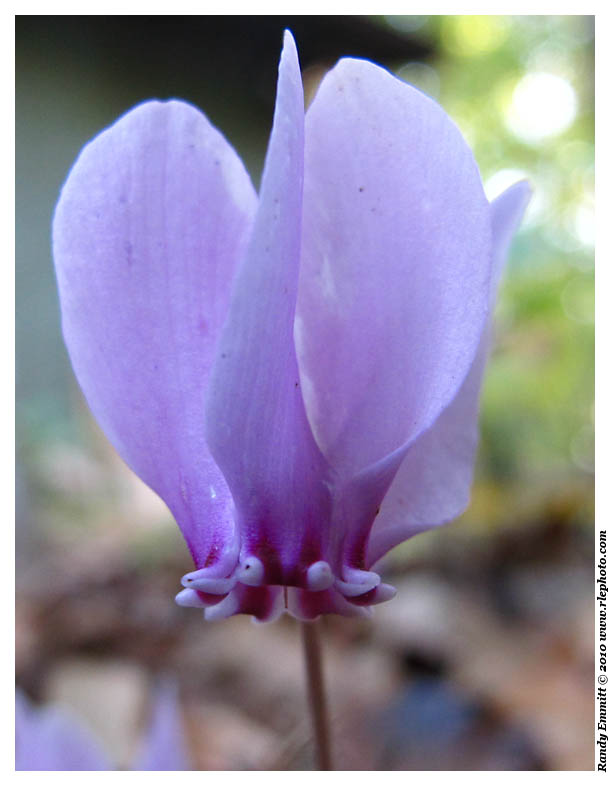
We are down to 3 cyclamen flowers right now. I think at one point we had close to 15 blooming at one time. I found some cyclamen corms at Southern States the other day one of the corms had a small bloom poking out of the bag! 
    Cyclamen if you turn it up to look at it from the bottom up! 
    I also planted in the garden today. Planted garlic, red onions, white onions, rape, mustard and lettuce.
     

Friday, November 20, 2009

Invasive Plants Garden Removal

I have been struggling with my best sunny location in the garden. Every year the invasive plants grab a little more from this bed. In 2009 I barely got any grip on it at all until the past few weeks.


Above in where the garden is located with a veiw of the pond, has room for lots of improvement. That huge clump of grass is a monster, the clump is likely 2-3 foot across and 8 foot high it has to go!

This bed had lots of wild black berries move in to the bed itself on the left side, I pulled them out weeks ago. In the front this 'annual' ornamental grass with blackish seed heads was grabbing the left and center front lawn hiding my Tennessee flat rock wall altogether. The center of the garden was(still is) this mountain mint given to me by a friend, it has taken over the entire center of the bed and mixed in with the ornamental grass in the center front. On the right side front there was 8-10 huge Bronze Fennels, I have pulled them out with 2 foot long roots. Between all of this are some beautiful large plox, some asters and salvias all mostly hidden in the mess this garden is.

My plan is to make a stone/treated lumber path along the back side of the garden on the pond slope and build a retaining wall out of concrete blocks, wine bottles (yes I said wine bottles)and stones set in a homemade mortar.


Above is the proposed path with the white arrows, it is fairly steep and some drainage comes there. The bed itself drops down about a foot on the back side right now, hoping I'll be able to level it off more and swale away the drainage at the same time or put in a drainage pipe under the garden.


Click on any of these images to enlarge them.
Above the white arrows show phase one, the path for the first garden patch. The red arrows show where I'll dig in some stone steps down to the pond, this is about 12 or so steps I think. The pink arrows show the proposed path for the second garden path phase three.


The paths I hope will be my weed control, before you could not walk behind the garden unless it was bone dry, otherwise the mud would slide you down the hillside. So this allowed the weeds go crazy and eventually walking was blocked by the weeds. The paths will be a lot of work digging and moving the soil on the hillside by hand. Hoping the end result will make the curb appeal awesome.

So you might ask what I have been doing with the weeds I have been pulling? I haul the weeds to behind the pond where I have a weed pile filling the ravine and setting the plants in the air so they can not set in roots (lets hope anyway). That pile could easily fill a large dump truck.

Friday, November 13, 2009

What to do after all the rain? Pull weeds

Guess we got at least 6 inches of rain the past three days. The rain stopped this morning it was windy and a chilly 50 degrees. I'd been cooped up to long and decided to get outside despite of the cold and windy weather. First task to replace the tire on my wheelbarrow, Meg was getting tired of me taking her wheelbarrow off to do jobs.

Anyway since Meg moved in here I've not done any burns around the pond, she's scared to death we'll burn the place down. Our Spring Peepers and Upland Chorus Frogs appreciate our not burning too. So my big flower bed by the driveway and next to our road had became more of a blackberry patch than a garden, what a mess!

All the big green stuff in the center is wild blackberries, the large grass is an annual grass that grows big black flowers(if you can call them flowers), this stuff needs to go, it is getting to invasive. Daisy was enjoying being outside and not getting soaked for a change.


Below is the second wheelbarrow load of blackberries, some canes were 12-15 ft long and 3/4 inches thick. The roots came out better than when it is dry.


Below is the actual flower bed, YEAH. I'll have to pull out all the rocks and dig out the remaining blackberry roots. This bed used to have tall bearded iris and monarda, yep killed the monarda. There is still some Apple Mint I'm sure it'll make new roots over the winter in this bed. Apple Mint blooms a long time and is an amazing butterfly attractor, but is very invasive.

Time to take wheelbarrow load number two to the ravine. Still a lot of work to clear this bed of invasives, but at least it is accessible now.


We received our order from Brent and Becky's Bulbs today.
Below is a Eremurus himalaicus (foxtail lily) root.
Thought it looked like a mean and nasty spider!

Does any here grow these and how deep should we plant it? It is supposed to get dense florets of pure white on 6-7 foot tall stems.

The Muscari 'Golden Fragrance' came in today as well, I was not expecting such huge bulbs (quarter size)on a muscari. Looking forward to seeing these banana looking muscari in bloom, totally new to me.

Wednesday, August 12, 2009

Butterflies and weeds

My last post was about invasive weeds, bamboo grass. This post is about weeds that butterflies use as host plants. I used to madly pull up Pearly Everlasting and Pussytoes in my former yard. I did not know then that the American Lady used it as a food plant. Here in paradise there is not much of it in the lawn or garden, there is a lot in the road easement out at the main road though.

The female here is depositing eggs. These American Ladies are common here, rarely we get Painted Ladies to stop in.

American Lady on pussytoes see my page on American Ladies here.
These 2 photos were taken 2 doors down from me at an estate on 300+ acres, I now have permission to roam the estate freely. I found out there is the ruins of a pre-civil war mill called Old Turner Mill on the North Fork of the Little River beside the property. I'll be exploring that once the rainy weather quits.

Nothing to exciting you might think looking at this dull little skipper. Wait these are uncommon to rare and we get at least 2 broods of them here at paradise most years. This is an Hayhurst's Scallopwing, Staphylus hayhurstii and less than 1 inch across with the wings open. When the wings are closed it is the size of a pinky fingernail. More on this little skipper can be found at my Butterflies of the Carolina & Virginias Website.
Another testy weed you think, well yes it is Lambsquarters, Chenopodium album
Lambsquarters can be difficult to control. I pull out the ones in the way and leave a few for the Hayhurst's Scallopwing to use as a food plant.


Silvery Checkerspot, Chlosyne nycteis these brushfoot butterflies visit us once in a while. Wingstems and sunflowers are the food plants for these and there are lots of these native plants growing along the North Fork of the Little River not far from here. More at my web page on the Silvery Checkerspot.


Bonus image! Great Blue Skimmer, Libellula vibrans. This medium sized dragonfly likes landing on antenneas, any upright perch or as in this case a purple rope. Usually they like to hang around woodland edges and our gardens is that exactly.

Tuesday, April 07, 2009

Tilling dirt and chopping up roots


Here are some wild morning glories that sprouted in our new garden bed. The soil was tilled up and placed in the garden back in early February. I figured chopping up the roots would just add organic matter. But I was wrong the chopping just helped the morning glories spread to every part of the garden. Usually when tilling I try to remove as much root material as possible, especially wild onions and mints. This time you can see the results below.

Above are 6 pieces of morning glory root I pulled up by hand. You can clearly see how new plants just took off from the small pieces of root.

I recall a long time ago at our river camp on the Ohio River it had wild morning glory roots 1 - 1 1/2 inches wide that came to surface every time the river washed away the soil. You could break off the roots like sweet potatoes, I had read that Indians ate the roots like potatoes in fact.

On a brighter note here is a Bleeding Heart from our garden today. A mild freeze is expected tonight, but there is nothing in our garden to worry about yet.