Yesterday Meg and I looked at a house with a workshop and an acre pond, it was on 11 acres. Having walked the property in the 90+ degree heat with nowhere to escape the sun I came to appreciate our shady location a great deal more. In our yard there is nowhere that you can be in the sun and not escape it in a matter of seconds.
After walking perhaps a 1/4 mile around the pond on the property, the thought of keeping the emergent trees at bay and mowing the lawns seemed daunting. Mowing our place takes 30 minutes with a push mower.
Exciting news on the bee front! I'm lining up a feral bee hive that is in a dying tree in Carrboro. The hive is 8 years old, the plan is to have the tree service cut out the hive in this large water oak. The portion of the tree that it is in is about 15 inches in diameter. So he'll cut the hive out, we'll secure the top and bottom and retrieve the hive after dark so all the bees will return to the hive. We'll screen the entrance and carry the hive home. Not planning on transferring the bees to a box hive until spring. Meg had told me she did not want any more hives here, but a wild hive really peaks her interest so she wants me to bring it home.
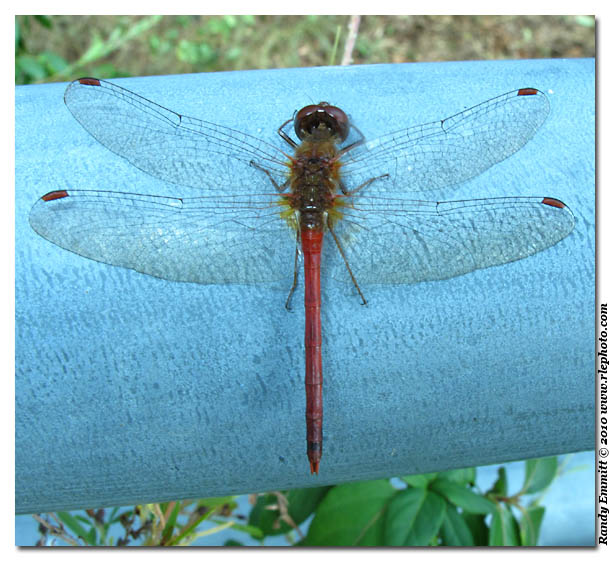
Thought I'd share with you a few dragonfly photos I took recently. Above is the Dragonhunter, which is a really big dragonfly, known for hunting other dragonflies. Dragonhunters can be seen patroling up and down rivers in a "J" postion as they patrol. Below is a Swift Setwing, these photos were taken along the Eno River not far from here.
Showing posts with label dragonflies. Show all posts
Monday, August 06, 2012
Saturday, June 30, 2012
June heat wave
Folks,
April and May were very wet and the garden became lush because of the damp weather. June has been hot, yesterday and today were supposed to perhaps reach 105 degrees f..... The next few days at least 100 degrees.
I'm almost done with my big deck and porch project in Chapel Hill see my post here is a sample photo of my handywork. The landscaper is coming soon to fill in the bottom of those stairs. I might build a play house at the bottom of the hill also.
Back to our garden. Saw this male Black Swallowtail that just emerged next to my bees the other morning. Meg usually collects caterpillars in our garden and her second grade class raises them. We have very young caterpillars right now, they will be finished by July18th when school starts back.
I cleaned up about one third of the ponds edge, bet I carried close to 200 pounds of black berry canes up the hillside while cleaning up. Hoped to get better access to see frogs and dragonflies. Best photo thus far was taken in the main garden. Here is a Great Blue Skimmer easily told by the white face and large size.
Back in 2008 we planted these black-eyed Susans, they barely have lived through all the droughts we have had. And they are planted a bit too much in the shade and just out of reach of the sprinkler. I'm sure it has been three years since we saw a bloom!
Holly Hocks these were planted last year, two seasons before they bloomed, very lovely indeed with blooms over 3 inches each beautiful.
So Meg has been on and off mad at me for not going on a vacation. Just too many unfinished projects to do , my customers waiting way too long and our two elderly dogs now need cleaned up after almost daily. We could not find a house sitter to take care of them nor did we want to drop them off at a kennel. The new cat we named Manny he's a real cut up most of the time. Mad at me tonight for closing the back door on him, it was 100 degrees outside and I left the back door open for a seconds as I filled a glass of water then pushed it closed, he screamed and ran away mad, never knew he was there.
The bees are doing great. My smallest hive Lindsey has for a week had more bees on their porch than the other 4 hives here combined. They lack having much comb and I just started feeding them. My bees at Scott and Paige's garden looked like they made no gains in the past 3-4 weeks, I gave them some syrup on Friday morning and instantly saw 4 bees with pollen! My busiest hive in the farm hive those bees are smoking. The five hives here all seem to be doing well.
April and May were very wet and the garden became lush because of the damp weather. June has been hot, yesterday and today were supposed to perhaps reach 105 degrees f..... The next few days at least 100 degrees.
I'm almost done with my big deck and porch project in Chapel Hill see my post here is a sample photo of my handywork. The landscaper is coming soon to fill in the bottom of those stairs. I might build a play house at the bottom of the hill also.
Back to our garden. Saw this male Black Swallowtail that just emerged next to my bees the other morning. Meg usually collects caterpillars in our garden and her second grade class raises them. We have very young caterpillars right now, they will be finished by July18th when school starts back.
I cleaned up about one third of the ponds edge, bet I carried close to 200 pounds of black berry canes up the hillside while cleaning up. Hoped to get better access to see frogs and dragonflies. Best photo thus far was taken in the main garden. Here is a Great Blue Skimmer easily told by the white face and large size.
Back in 2008 we planted these black-eyed Susans, they barely have lived through all the droughts we have had. And they are planted a bit too much in the shade and just out of reach of the sprinkler. I'm sure it has been three years since we saw a bloom!
Holly Hocks these were planted last year, two seasons before they bloomed, very lovely indeed with blooms over 3 inches each beautiful.
So Meg has been on and off mad at me for not going on a vacation. Just too many unfinished projects to do , my customers waiting way too long and our two elderly dogs now need cleaned up after almost daily. We could not find a house sitter to take care of them nor did we want to drop them off at a kennel. The new cat we named Manny he's a real cut up most of the time. Mad at me tonight for closing the back door on him, it was 100 degrees outside and I left the back door open for a seconds as I filled a glass of water then pushed it closed, he screamed and ran away mad, never knew he was there.
The bees are doing great. My smallest hive Lindsey has for a week had more bees on their porch than the other 4 hives here combined. They lack having much comb and I just started feeding them. My bees at Scott and Paige's garden looked like they made no gains in the past 3-4 weeks, I gave them some syrup on Friday morning and instantly saw 4 bees with pollen! My busiest hive in the farm hive those bees are smoking. The five hives here all seem to be doing well.
Labels:
butterflies,
deck projects,
dragonflies,
hollyhocks
Wednesday, June 01, 2011
Eastern least Clubtail
On Monday I went walking in Johnston Mill Nature Preserve along New Hope Creek. Right where the mill used to be I met a man and his son, later I ran into them and they told me they had seen 2 dragonflies emerging on rocks in the creek. So I went back to look for the newly emerged dragonflies, all that remained were the exuvias. Now my shoes were wet so I decided to look for my own emerging. It did not take long to find some emerging dragonflies. Turns out they were Eastern Least Clubtails - Stylogomphus albistylus, exactly what I'd hoped to find.
This female Eastern Least Clubtail was just barely out of the water on that tiny rock. If the water had been rising, this would have been fish food for sure. Bad news is she was still in the exuvia when I found her, but my big camera died from all the sweating, it was 90 plus degrees out there.
Same female expanding her body.
Different female at least she picked a bigger rock. I took 2 photos with my little camera from about an inch away and she flew into the trees. The big exuvia is hers, the tiny one in a damselfly exuvia.
Here is an mature Eastern Least Clubtail, from the same spot on New Hope Creek in 2004 a few weeks later in the season. As you can see teneral (immature) dragonflies can be difficult to tell what they are when they first emerge.
This female Eastern Least Clubtail was just barely out of the water on that tiny rock. If the water had been rising, this would have been fish food for sure. Bad news is she was still in the exuvia when I found her, but my big camera died from all the sweating, it was 90 plus degrees out there.
Same female expanding her body.
Different female at least she picked a bigger rock. I took 2 photos with my little camera from about an inch away and she flew into the trees. The big exuvia is hers, the tiny one in a damselfly exuvia.
Here is an mature Eastern Least Clubtail, from the same spot on New Hope Creek in 2004 a few weeks later in the season. As you can see teneral (immature) dragonflies can be difficult to tell what they are when they first emerge.
Monday, May 30, 2011
Clamp-tipped Emerald
On Saturday I ventured down the Eno River at Guess Road in Durham, NC. It had rained a lot the day before, the Eno was still up a little, it empties quickly. My first part of the walk was very wet, my pants got soaked walking the trail with wet grass covering the trail.
I found this female Clamp-tipped Emerald, Somatochlora tenebrosa that had recently emerged from its exuvia. In the 12 years or so I have been watching and photographing Odonata this was my third one of this species. I have yet to find a male, odds are I have seen them flying but could not ID them in the past. They lay eggs in small shady streams, I have witnessed a female "hammering" her eggs along small streams before. I suspect this one got washed out of a small stream into the Eno River.
Clamp-tipped Emerald - Somatochlora tenebrosa
Clamp-tipped Emerald Exuvia (discarded larval casing)
Near the bottom of her abdomen you can see her ovapositor pointing nearly 90 degrees from her body. Once these dragonflies age they look very dull in comparison to this one.
I found this female Clamp-tipped Emerald, Somatochlora tenebrosa that had recently emerged from its exuvia. In the 12 years or so I have been watching and photographing Odonata this was my third one of this species. I have yet to find a male, odds are I have seen them flying but could not ID them in the past. They lay eggs in small shady streams, I have witnessed a female "hammering" her eggs along small streams before. I suspect this one got washed out of a small stream into the Eno River.
Clamp-tipped Emerald - Somatochlora tenebrosa
Clamp-tipped Emerald Exuvia (discarded larval casing)
Near the bottom of her abdomen you can see her ovapositor pointing nearly 90 degrees from her body. Once these dragonflies age they look very dull in comparison to this one.
Sunday, May 22, 2011
Saturdays Bugs
On Saturday I took three leisurely walks at the Eno River State Park. Given the park is along the river you can stop lots of places to hike and explore. I had hoped to find some Splendid Clubtails, rare here in the Piedmont of North Carolina. Since we have had lots of rain this spring the clubtails might have washed away and perished while emerging along the shore as the river came up, it happens. Or it might just be early for them still.
Here are some photos taken with my big camera for a change. I've wanted to update and get a new one for several years but have not been able to afford it.
A Pair of Eastern Tailed-blues mating. These butterflies are plentiful at times in our lawn and garden.
This is from our pond before i went on a walk. A baby Eastern Painted Turtle, the pond has lost of these turtles.
Female dark form Eastern Tiger Swallowtail taking in ray from the sun to warm herself.
Hackberry Emperor my first of the season, it was teasing me at the entrance to the trails at Fews Ford. Normally hackberries do not have such pointed wings, first I have seen like this, it is a male btw. Anyone want to guess the host plant on this butterfly?
This butterfly and the one below are or can be tricky to ID. Above is a Question Mark, look at the dark round spots on the forewing. Notice 4 dark spots in a row on the forewing only Question Marks have 4 spots.
Here is an Eastern Comma, both the Question Mark and Eastern Commas were flying together and perching in the mud along the river in good numbers. OK now look at the dark spots on the forewing there are 3 dark spots telling us it is an Eastern Comma.
Last week I walked the Cole Mill Power line and saw 6 of these Great Spangled Fritillaries. Yesterday I must have seen 60 in the same location. Normally we are on the southeastern end of this butterflies range seeing 6 is great, 60 might be a record. I have seen over 200 Great Spangled Fritillaries 50 miles north of here in the past. Last week the power line had around 50 Silvery Checkerspots, this week only 3 they are on the way to finishing their brood. Gotta love the way nature changes all the time.
One of the 13 year cicadas. They seemed a tad louder on my walk yesterday, more flying about and perched in small trees and shrubs. I did not see any deformed wing ones at all. I did notice a fair number freshly dead on the pavement, they are starting to die now it seems. I've really enjoyed them myself.
Today's discovery is I call hear cicadas calling in the distance here at paradise! I walked about for 2 hours hearing therm faintly most of the time, yet found no visible signs of them in the air, trees or ground.
The power line is loaded with Ox-eyed Daisies this American lady posed nicely on them. The daisies have been blooming a long time, the butterflies are not using them as much as last week.
Here was my target for last weeks hike in the power line, I finally found one yesterday. It is an Arrowhead Spiketail, they are over 3 inches long a big dragonfly! This one let me get up close and take lots of photos.
Any guesses to why it is called an Arrowhead Spiketail?
Here is the Question Mark seen from the side it was investigating owl droppings and let me approach take photos and walk away, must have been good stuff. The cream marks in the hindwing resemble a Question mark don't they.
The bees are doing fine drinking syrup like crazy, it'll be a full time job making syrup for them. They are drinking about a quart a day of sugar syrup. I make the syrup by heating up 6 cups of water and adding 6 cups of sugar to it and dissolving it. I watched them yesterday morning arriving back to the hive. I noticed 3 bees carrying pollen out over a 100 bees, hope that will improve. The biggest season for pollen collection just ended. Tulip Poplar and blackberries are done, this leave main sources like clover and other flowers not in great abundance.
Around 5 pm I went out there and over 100 bees were swirling about the front of the hive looking confused. Did not know what to do, so I called Monica at the bee company. Here is what Monica had to say: It sounds like the bees are orientating to the hive, or it could be that they were doing their "cleansing" flight. After 30 minutes they were back to normal. Its going to be very hot today if they do this again I'll take video of it for the blog.
One last thing I saw a lot of snakes yesterday starting with a Rat Snake in the bluebird box :((( looking out at me. On the Eno I saw 5-6 Northern Water snakes and this morning I found our first yard Northern Water snake in the pond on a stick. Also had a grass snake in a big tree on the Eno. Today I checked our snake tins (snake tins are metal roofing laying on the ground for snakes to get under. Anyway I lifted the tins and found a worm snake and the largest Ringed-neck Snake I have ever seen 18 inches or more. Both these snakes eat slugs great to have in the garden.
Here are some photos taken with my big camera for a change. I've wanted to update and get a new one for several years but have not been able to afford it.
A Pair of Eastern Tailed-blues mating. These butterflies are plentiful at times in our lawn and garden.
This is from our pond before i went on a walk. A baby Eastern Painted Turtle, the pond has lost of these turtles.
Female dark form Eastern Tiger Swallowtail taking in ray from the sun to warm herself.
Hackberry Emperor my first of the season, it was teasing me at the entrance to the trails at Fews Ford. Normally hackberries do not have such pointed wings, first I have seen like this, it is a male btw. Anyone want to guess the host plant on this butterfly?
This butterfly and the one below are or can be tricky to ID. Above is a Question Mark, look at the dark round spots on the forewing. Notice 4 dark spots in a row on the forewing only Question Marks have 4 spots.
Here is an Eastern Comma, both the Question Mark and Eastern Commas were flying together and perching in the mud along the river in good numbers. OK now look at the dark spots on the forewing there are 3 dark spots telling us it is an Eastern Comma.
Last week I walked the Cole Mill Power line and saw 6 of these Great Spangled Fritillaries. Yesterday I must have seen 60 in the same location. Normally we are on the southeastern end of this butterflies range seeing 6 is great, 60 might be a record. I have seen over 200 Great Spangled Fritillaries 50 miles north of here in the past. Last week the power line had around 50 Silvery Checkerspots, this week only 3 they are on the way to finishing their brood. Gotta love the way nature changes all the time.
One of the 13 year cicadas. They seemed a tad louder on my walk yesterday, more flying about and perched in small trees and shrubs. I did not see any deformed wing ones at all. I did notice a fair number freshly dead on the pavement, they are starting to die now it seems. I've really enjoyed them myself.
Today's discovery is I call hear cicadas calling in the distance here at paradise! I walked about for 2 hours hearing therm faintly most of the time, yet found no visible signs of them in the air, trees or ground.
The power line is loaded with Ox-eyed Daisies this American lady posed nicely on them. The daisies have been blooming a long time, the butterflies are not using them as much as last week.
Here was my target for last weeks hike in the power line, I finally found one yesterday. It is an Arrowhead Spiketail, they are over 3 inches long a big dragonfly! This one let me get up close and take lots of photos.
Any guesses to why it is called an Arrowhead Spiketail?
Here is the Question Mark seen from the side it was investigating owl droppings and let me approach take photos and walk away, must have been good stuff. The cream marks in the hindwing resemble a Question mark don't they.
The bees are doing fine drinking syrup like crazy, it'll be a full time job making syrup for them. They are drinking about a quart a day of sugar syrup. I make the syrup by heating up 6 cups of water and adding 6 cups of sugar to it and dissolving it. I watched them yesterday morning arriving back to the hive. I noticed 3 bees carrying pollen out over a 100 bees, hope that will improve. The biggest season for pollen collection just ended. Tulip Poplar and blackberries are done, this leave main sources like clover and other flowers not in great abundance.
Around 5 pm I went out there and over 100 bees were swirling about the front of the hive looking confused. Did not know what to do, so I called Monica at the bee company. Here is what Monica had to say: It sounds like the bees are orientating to the hive, or it could be that they were doing their "cleansing" flight. After 30 minutes they were back to normal. Its going to be very hot today if they do this again I'll take video of it for the blog.
One last thing I saw a lot of snakes yesterday starting with a Rat Snake in the bluebird box :((( looking out at me. On the Eno I saw 5-6 Northern Water snakes and this morning I found our first yard Northern Water snake in the pond on a stick. Also had a grass snake in a big tree on the Eno. Today I checked our snake tins (snake tins are metal roofing laying on the ground for snakes to get under. Anyway I lifted the tins and found a worm snake and the largest Ringed-neck Snake I have ever seen 18 inches or more. Both these snakes eat slugs great to have in the garden.
Saturday, November 06, 2010
Checkered What?
Last night it was down in the low 30s, I heard reports of freezing rain this morning when I was at the Hillsborough Farmers Market. Nothing look frosted though. Tonight we should have our first hard freeze, the banana tree will tell the whole story in the morning I guess.
All day it looked like a winter day being mostly overcast with lots of dark moving clouds. I met two friends for a nature walk in the Butner Gamelands at 1 pm. We did not expect to find much in the way of butterflies as it was lucky to be 50 degrees most of the day. My friend Owen is on top of mushroom identification and has been doing mycology for many years. So we looked in the woods for mushrooms, no exciting finds in the way of mushrooms other than two kinds of puffballs.
Roger found this uncommon to rare butterfly a female Checkered White featured above and below. Here in North Carolina there is no place you can reliably find the Checkered White, out in the western US it can be very common. It was so cold that it let us pick it up. Normally with my little Canon G11 trying to get a close up of this butterfly would be impossible. Once the sun came out (for 10 minutes) it spread its wings and flew away.
Below is a Common/White Checkered Skipper when the sun was out I saw maybe 20 of these little guys. Never have I photographed both butterflies with checkered in their names on the same day. The cold was the only reason I was able to get my G11 up close to this busy skipper.
This mustard in planted in 20 ft rows for maybe a mile, in the fall this can be the place to find butterflies near Durham. Like our Carolina Blue skies?
Always a treat on a cold day, a male Autumn Meadowhawk perched carefully on a gate pipe. It was so cold it took 5-6 landing attempts before it obtained a resting place. Two of these were seen only by yours truly today, the other landed on my breast pocket while walking along.
We also found some cool oak trees, Swamp Chestnut Oak and Overcup Oak. The overcup acorns always make my day when I find them.
All day it looked like a winter day being mostly overcast with lots of dark moving clouds. I met two friends for a nature walk in the Butner Gamelands at 1 pm. We did not expect to find much in the way of butterflies as it was lucky to be 50 degrees most of the day. My friend Owen is on top of mushroom identification and has been doing mycology for many years. So we looked in the woods for mushrooms, no exciting finds in the way of mushrooms other than two kinds of puffballs.
Roger found this uncommon to rare butterfly a female Checkered White featured above and below. Here in North Carolina there is no place you can reliably find the Checkered White, out in the western US it can be very common. It was so cold that it let us pick it up. Normally with my little Canon G11 trying to get a close up of this butterfly would be impossible. Once the sun came out (for 10 minutes) it spread its wings and flew away.
Below is a Common/White Checkered Skipper when the sun was out I saw maybe 20 of these little guys. Never have I photographed both butterflies with checkered in their names on the same day. The cold was the only reason I was able to get my G11 up close to this busy skipper.
This mustard in planted in 20 ft rows for maybe a mile, in the fall this can be the place to find butterflies near Durham. Like our Carolina Blue skies?
Always a treat on a cold day, a male Autumn Meadowhawk perched carefully on a gate pipe. It was so cold it took 5-6 landing attempts before it obtained a resting place. Two of these were seen only by yours truly today, the other landed on my breast pocket while walking along.
We also found some cool oak trees, Swamp Chestnut Oak and Overcup Oak. The overcup acorns always make my day when I find them.
Sunday, October 10, 2010
Last Dragonfly to Emerge of the Season
Today I was going to pull and cut weeds around the pond. I started yesterday with the front bed which was completely out of control with stilt grass and blackberries. The blackberries did not as well as they did last year because of our drought, the stilt grass didn't seem to care.
I made a new path along the sunny side of the pond and got distracted by the dragonflies flying in tandem over the pond. I knew instantly they were Autumn Meadowhawks (formerly called Yellow-legged Meadowhawks). So instead of weeding I ended up watching behavior and photographing the meadowhawks. The Autumn Meadowhawk is the last dragonfly to emerge in late summer or early fall here. I have seen them flying as late as December 10 here!
This pair of Autumn Meadowhawk, Sympetrum vicinum landed on this canna leaf for my first photo of this species in tandem. I think these are the only meadowhawks that fly in tandem and lay eggs as they fly together over the water. Tandem is not mated, the male who is grasping the females head will wait for the female to swing her abdomen around to mate with him in the wheel position.
Here the female looks like she has her appendages open yet no eggs are visible. Never seen this before either. I watched for at least an hour and I saw a mated pair the entire time(when in sight) I was watching, no single females were seen.
I made a new path along the sunny side of the pond and got distracted by the dragonflies flying in tandem over the pond. I knew instantly they were Autumn Meadowhawks (formerly called Yellow-legged Meadowhawks). So instead of weeding I ended up watching behavior and photographing the meadowhawks. The Autumn Meadowhawk is the last dragonfly to emerge in late summer or early fall here. I have seen them flying as late as December 10 here!
This pair of Autumn Meadowhawk, Sympetrum vicinum landed on this canna leaf for my first photo of this species in tandem. I think these are the only meadowhawks that fly in tandem and lay eggs as they fly together over the water. Tandem is not mated, the male who is grasping the females head will wait for the female to swing her abdomen around to mate with him in the wheel position.
Here the female looks like she has her appendages open yet no eggs are visible. Never seen this before either. I watched for at least an hour and I saw a mated pair the entire time(when in sight) I was watching, no single females were seen.
Male Autumn Meadowhawk above and below. These photos look to be the best I have taken of this small 1 1/4 inch dragonfly! I saw 6 of these tiny beauties over and around our pond today!
male Southern Spreadwing, Lestes australis
Three of these were in the Johnson Grass on our pond today. At first I thought it was a new species for our pond the Swamp Spreadwing but the legs are not black. Then Sweetflag Spreadwing was another choice and I went back to the pond to photograph a female, the females can be disguised by the rear appendage which I managed to get a photo of to confirm Southern Spreadwing.
Friday, September 17, 2010
Melon rinds and butterflies!
This past week I had dropped a water melon rind next to the big Miss Huff lantana bush.Most of our melon rinds either go out the back door or into the compost bin. Anyway I dropped this rind in hopes of getting butterflies on it. You see below the results.
The orange butterfly is a Viceroy and the other is an related species the Red-spotted Purple. This brought me a lot of excitement and even though we have lots of willows (the host plant for both species) we rarely get Viceroys here. This also brought to mind that just over a year ago in South Carolina I saw a hybrid Viceroy, Red-spotted Purple with half the wings being like each species. I did not get a photo as the camera was 50 ft away in the car....
Here is the Viceroy again, you can see my page on them here. She posed nicely and I was able to get a few inches away with my little G11 camera.
More of the Red-spotted Purple with a Tawny Emperor (above). The camera flash kind of enhanced the ventral view a bit don't you think? The record here stands at 22 Red-spotted Purples on a half papaya that I got form the grocery for a quarter since it was nearly past prime. See my page on Red-spotted Purple.
Below is an Hackberry Emperor, I had two of these landing on the single melon rind along with 3 Tawny Emperors (a record number here BTW), the Red-spotted Purple, Viceroy, Question Mark, Gemmed Satyr and Carolina Satyr!
OK below is a dragonfly that I got photos of in Southport, NC, the last time I got photos of this one was in 2003.
This is a Four-spotted Pennant (Brachymesia gravida) they can only be found near brackish water, so you have to be along the coast to find them. Getting the ID is easy as it is the only dragonfly you will encounter along the coast with all white stigmas on the wings.
The orange butterfly is a Viceroy and the other is an related species the Red-spotted Purple. This brought me a lot of excitement and even though we have lots of willows (the host plant for both species) we rarely get Viceroys here. This also brought to mind that just over a year ago in South Carolina I saw a hybrid Viceroy, Red-spotted Purple with half the wings being like each species. I did not get a photo as the camera was 50 ft away in the car....
Here is the Viceroy again, you can see my page on them here. She posed nicely and I was able to get a few inches away with my little G11 camera.
More of the Red-spotted Purple with a Tawny Emperor (above). The camera flash kind of enhanced the ventral view a bit don't you think? The record here stands at 22 Red-spotted Purples on a half papaya that I got form the grocery for a quarter since it was nearly past prime. See my page on Red-spotted Purple.
Below is an Hackberry Emperor, I had two of these landing on the single melon rind along with 3 Tawny Emperors (a record number here BTW), the Red-spotted Purple, Viceroy, Question Mark, Gemmed Satyr and Carolina Satyr!
OK below is a dragonfly that I got photos of in Southport, NC, the last time I got photos of this one was in 2003.
This is a Four-spotted Pennant (Brachymesia gravida) they can only be found near brackish water, so you have to be along the coast to find them. Getting the ID is easy as it is the only dragonfly you will encounter along the coast with all white stigmas on the wings.
Saturday, June 26, 2010
Odes from WV 2 day trip!
This past week we stopped on the way back from my nephews wedding to camp at Spruce Knob in the mountains of WV. One Monday and Tuesday I spent about 6 hours a day trekking around Spruce Knob Lake and a beaver pond ditch below the lake. Also looked around Gandy Creek for odes as well.
I'll do a post after this with a lot of butterfly photos as soon as I get a chance.
Found lots of these in small rocky creeks perched on the rocks, my first for West Virginia. I have not seen this species in many years since I found females perched in trees in western North Carolina. Will Cook's page on this species

I'll do a post after this with a lot of butterfly photos as soon as I get a chance.
Male Superb Jewelwing, Calopteryx amata
Female Superb Jewelwing photo above and below.
These were found along Gandy Creek. Gandy Creek only had Superb and Ebony Jewelwings and Common Whitetails.
Hagen's Bluet, Enallagma hageni (male)
These are hard to ID just from a photo like this, so I could be wrong on the ID.
I featured this damselfly on another recent posting it is a male
Aurora Damsel, Chromagrion conditumFound at the back of Spruce Knob Lake and a singleton along Gandy Creek
More on this species at Jim Bangma's website
Variable Dancer, Argia fumipenni or Violet Dancer, Argia fumipennis violacea (male)
The Variable Dancers where we live have amber tinted wings, these northern ones do no have tinted wings.
The above photo is a female Eastern Forktail, Ischnura verticalis
and the photo below is the male Eastern Forktail.
There are records of this species in our area but I have failed to find them, in WV they are very common. You can find out more about them at Stephen's website
Brown Spiketail, Cordulegaster bilineata
I saw several of these in the back waters of Spruce Knob Lake and below the beaver pond. They pose nicely for photos. See Jeff Pippen's page for more info.
Not sure on the ID here these are meadowhawks but given the difficulty to ID them I can't say for sure. Female above and male below. My guess would be Ruby Meadowhawk, but it just a guess.
Aurora Damsel, Chromagrion conditumFound at the back of Spruce Knob Lake and a singleton along Gandy Creek
More on this species at Jim Bangma's website
Variable Dancer, Argia fumipenni or Violet Dancer, Argia fumipennis violacea (male)
The Variable Dancers where we live have amber tinted wings, these northern ones do no have tinted wings.
The above photo is a female Eastern Forktail, Ischnura verticalis
and the photo below is the male Eastern Forktail.
There are records of this species in our area but I have failed to find them, in WV they are very common. You can find out more about them at Stephen's website
Brown Spiketail, Cordulegaster bilineata
I saw several of these in the back waters of Spruce Knob Lake and below the beaver pond. They pose nicely for photos. See Jeff Pippen's page for more info.
Not sure on the ID here these are meadowhawks but given the difficulty to ID them I can't say for sure. Female above and male below. My guess would be Ruby Meadowhawk, but it just a guess.
Unicorn Clubtail, Arigomphus villosipes
above and below photos.
These were found in good numbers at the top of the beaver pond and the back of Spruce Knob Lake. Stephen's site on this species
I reported these incorrectly they are male Southern Pygmy Clubtail, Lanthus vernalisabove and below photos.
These were found in good numbers at the top of the beaver pond and the back of Spruce Knob Lake. Stephen's site on this species
Found lots of these in small rocky creeks perched on the rocks, my first for West Virginia. I have not seen this species in many years since I found females perched in trees in western North Carolina. Will Cook's page on this species

Twelve-spotted Skimmer, Libellula pulchella
Saw more of these than I ever have around the beaver pond there were more than 3 dozen alone flying all about chasing each other. Stephen's page on these.
Chaulk-fronted Corporal, Ladona julia
Saw fewer of these than most of the times I visited Spruce Knob Lake and they usually are easy to photograph, not this year. Jim's page on these.
Calico Pennant, Celithemis elisa (male)
The most common dragonfly we saw.
They were everywhere I estimated seeing at least 150 of them.
Male Dot-tailed Whiteface, Leucorrhinia intacta
My first for West Virginia, I have seen them in Maryland and Pennsylvania
Stephen's page on this species
Wait until I get to the butterflies!
The most common dragonfly we saw.
They were everywhere I estimated seeing at least 150 of them.
Male Dot-tailed Whiteface, Leucorrhinia intacta
My first for West Virginia, I have seen them in Maryland and Pennsylvania
Stephen's page on this species
Wait until I get to the butterflies!
Subscribe to:
Posts (Atom)